
A wildfire can damage a community without burning a single building.
During a prolonged smoke event, emergency room visits may rise for both respiratory and mental health conditions. Outdoor work can stop. Parents may miss shifts to care for children. Tourism and restaurant revenues can fall. Workers who cannot afford to lose a week’s pay may experience consequences that last well beyond the event itself.
Those are the kinds of costs Dr. Soodeh Saberian wants to make visible.
Saberian, TRU’s new Canada Research Chair in Economics of Climate Change, Disasters and Inequality, studies the consequences of environmental problems that often go uncounted.
“When a wildfire burns, we count the hectares and the houses. Those numbers are real, but they are the small part. The larger part is what happens to everyone who never saw a flame,” she said.
“I try to make that invisible damage visible and countable, so it can be weighed properly when decisions get made.”
Looking beyond the smoke
For Saberian, economics offers a way to connect individual experiences to the broader effects of climate change and environmental disasters.
“Climate scientists can tell you how much smoke is in the air. Doctors can tell you what smoke does to a set of lungs,” she said. “Economists ask a different question: what happens to a person’s whole life when that smoke arrives, and who ends up paying for it?”
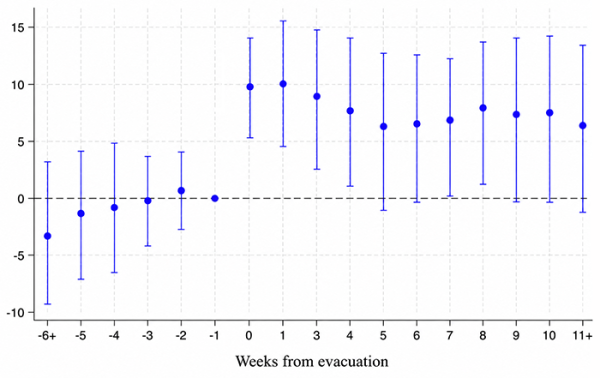
Costs that never get recorded as wildfire damage — hospital visits for mental health conditions rise sharply in the weeks following an evacuation order and remain elevated afterward.
Using naturally occurring differences, economists can tease out cause and effect. Smoke, for example, may settle over one community while leaving another nearby relatively unaffected. Comparing what happens in households, workplaces and local economies in those places can offer insight into what the smoke itself caused.
When outdoor work stops, some workers can absorb a lost week of pay and some cannot, and that difference compounds. The health system carries costs for months afterward. Saberian and her colleagues have found increases in hospital visits for mental health conditions after evacuation orders, levels that stay elevated for weeks.
“Not one of those things gets recorded as wildfire damage,” Saberian said. “Added up, they can rival the physical destruction.”
When the costs are unequal
A central part of Saberian’s research is understanding why the same environmental event can affect people very differently.
“If you work indoors in a filtered office, a smoky week is unpleasant. If you frame houses or pick fruit or drive a truck, it is your health or your income — you have to choose. I worry most about people who can’t buy their way out of exposure,” she said.
Renters are less likely to be able to install filtration systems than homeowners, and older buildings allow more smoke inside than new ones. In rural and remote communities, including many Indigenous communities, wildfire risk is higher while health services are more limited. Less access to care, more difficult evacuations and less influence over decision-making can all increase the burden.
“Understanding these differences matters because averages hide them,” Saberian said.
“A policy designed for the average resident will miss the people carrying most of the burden, and those are usually the people with the least capacity to absorb it. If you don’t measure who is hit hardest, you end up spending money where it does the least good.”
Putting human costs into the calculation
Saberian hopes measuring these hidden costs will change how governments assess investments in forest management, prescribed burns or clean-air shelters. If health costs are included alongside damage to buildings and infrastructure, prevention can look like a much better investment.
She would also like to see mental health treated as a frontline part of disaster response. Evidence that hospital visits for mental-health conditions rise during wildfire events means communities can plan and staff services accordingly.
“What I hope is that the accumulated evidence shifts the default assumptions, so the health and human costs are simply in the calculation from the start.”
Making the invisible measurable
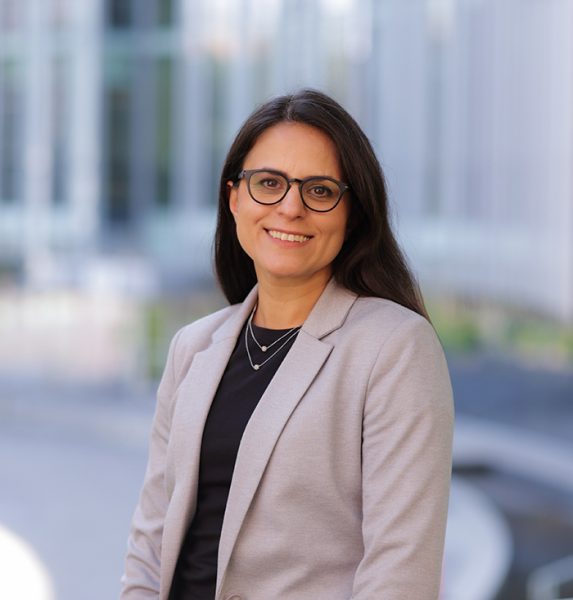
TRU researcher Dr. Soodeh Saberian wants to make the hidden costs of wildfire visible.
Saberian’s interest in those hidden costs began long before she became an economist.
“I grew up somewhere where bad air was simply a fact of the calendar,” she said. “Certain weeks of the year, you stayed inside. Schools closed. Everyone accepted it as weather, as something that happened to you rather than something anyone had decided.”
Training as an economist taught her to see those experiences differently: bad air carried measurable costs in missed school, missed work, hospital visits and even decision-making.
“Once I saw that the costs were measurable, I couldn’t stop wanting to measure them.”
Close to the questions
Saberian joined TRU’s Bob Gaglardi School of Business and Economics this summer after serving as an associate professor of economics at the University of Manitoba. She has also been a visiting research scholar at Princeton University’s Center for Health and Wellbeing and a research affiliate with the Institute of Labor Economics.
For her, Kamloops is an especially meaningful place to continue this work.
“Kamloops is not an abstract place to study climate change. Wildfire smoke, extreme heat, drought, evacuation orders: these are part of ordinary life in the Interior in a way they simply aren’t in most of the country,” Saberian said.
“Being close to the questions changes the questions you ask.”
TRU’s location creates opportunities to connect her work directly to the region. She hopes to build a research group where students can work with real-world data on problems affecting communities around them.
Saberian is especially interested in connecting with local community organizations, health authorities and First Nations that have questions her research could explore.
“Some of the most useful research questions I’ve worked on came from someone outside the university telling me what they actually needed to know.”
Saberian’s work connects to TRU Wildfire, a university-wide initiative advancing research, education, training and innovation to address current and future wildfire challenges. Learn more.