
Thompson Rivers University students are putting artificial intelligence to work on salmon conservation, turning classroom learning into technology designed to meet the needs of a community partner.
Developed in collaboration with the Skeetchestn Natural Resource Corporation (SNRC), their AI salmon monitoring system was installed July 2 at the Deadman River, in the traditional territory of Skeetchestn Indian Band. The system has spent the salmon run processing video footage, identifying fish and providing regular counts to SNRC.
For the data science and computing students and alumni behind the multi-year project, which stems from a 2024 agreement between SNRC and TRU, deployment marked the beginning of a new phase of testing and refining their AI technology.
From prototype to river
Original team members Taiwo Ogunkeye and Mint Thai joined the project as students in March 2025, under the supervision of Dr. Sean Hellingman, assistant professor in TRU’s Department of Mathematics and Statistics. In June, Ogunkeye graduated with a Master of Science in Data Science and Thai earned a Post-Baccalaureate Diploma in Applied Data Science, but both continued contributing as alumni as the system moved from the lab to the river.
Saifullah Chandio joined the team in September 2025 while completing his Bachelor of Computing Science capstone course. He helped program, test and refine the system to operate in real-world conditions with minimal manual intervention.
“When I joined the team, we had a prototype AI model that was working in a lab environment,” Chandio said. “My main responsibility was to take that prototype and deploy it in the actual Deadman Watershed environment, with processing as close to real time as possible.”
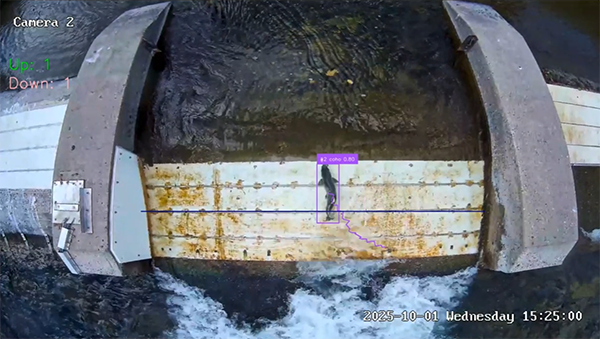
A still from video footage captured by the AI monitoring system, counting a coho salmon as it passes through the fish-counting weir.
Moving the system to the river required the team to solve problems across disciplines.
“There wasn’t a single stage of this project where everyone had a perfect answer to any problem, but the team really took up the challenge of pushing towards the finish line,” Ogunkeye said.
As more video became available, the team refined how data was annotated, how fish were counted and how their length was calculated. Newer cameras provided higher-resolution footage, improving the model’s ability to recognize salmon.
But fish don’t necessarily behave in ways that make life easy for data scientists. A salmon might begin swimming upstream, turn around and head downstream, and need to be recognized as one fish rather than counted twice. Fish travelling downstream with the current can also move much faster than those swimming upstream.
“I have learned that real-world data will never be 100 per cent perfect,” Ogunkeye said. “And fish are very pesky creatures to annotate and document.”
When AI meets the real world
The river presented other challenges the team could not fully anticipate in the lab.
As the salmon run progressed, a pad used in the monitoring system became darker and dirtier, at times resembling the salmon closely enough to confuse the AI model. After periods of heavy wind, a loose cable also caused problems with the video stream.
“It was a good reminder that when we take something out of the lab, we are not just testing our product anymore. We’re testing the entire system and everything it depends on,” Thai said.
The experience helped the team recalibrate the model and improve the system under changing field conditions.
The deployment also put one of the project’s main goals to the test: reducing the time fisheries specialists spend manually reviewing fish-counting data. Previously, technicians could spend months comparing raw data and verifying which records represented fish.
The new system processes video and automatically detects and counts salmon, providing weekly reports with information about migration events and fish size while the run is still underway. Human verification continues as SNRC compares the AI-generated results with validated counts.
“I actually think that’s an important part of deploying an AI system responsibly,” Thai said. “We’re not expecting people to immediately trust a new system just because we built it.”
Building technology people can use
The deployment is supported by Secwépemc Fisheries Commission biologists Jake Guerin, Shayne Kuchma and Ethan Milobar, with oversight from SNRC general manager Don Ignace and project coordinator Christina Radyo.
Working with fisheries specialists challenged the students to understand how the equipment, software and data work together, and how the system fits into the broader goals of salmon monitoring.
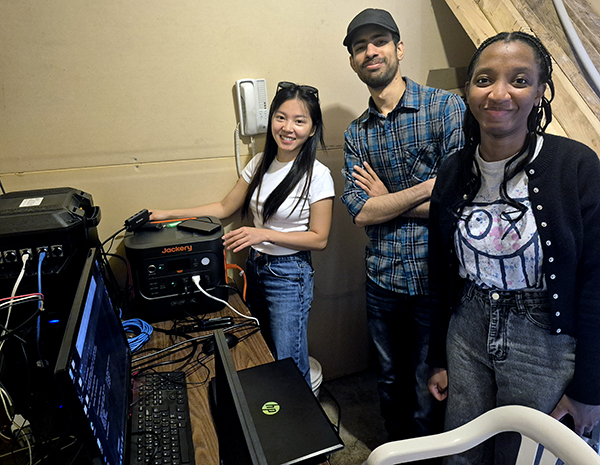
Mint Thai, Saifullah Chandio and Taiwo Ogunkeye deploying the system on site at the Deadman River.
“I learned that being a good developer is not only about writing code; it is also about understanding the problem, listening to the people who will use the system, and continuously refining the technology to meet their needs,” Chandio said.
For Chandio, who graduated this month, seeing the system support salmon conservation efforts gave the work significance beyond an academic assignment.
“It was very different from building a project just for a grade,” he said. “Knowing that the system was being used to support salmon monitoring gave the work a real purpose and made me more invested in getting the details right.”
Still ahead, the team will compare the system’s salmon counts with human-validated data to identify areas for improvement. One challenge is detecting downstream salmon, which were less common in the footage used to train the AI model. Further testing will determine whether the hardware can handle processing multiple video streams from two additional cameras.
Ogunkeye and Thai are also working with Hellingman on a research paper documenting the project, extending their applied learning into academic research. They hope to make the code used to develop the software system (minus the Indigenous-owned data) publicly available so that other researchers may use their approach.
All three alumni continue to contribute to the project. Chandio checks the system weekly to ensure it is functioning properly, while Thai monitors its performance, troubleshoots issues and works with fisheries specialists to resolve problems. Ogunkeye also remains available to contribute as the project moves forward.
This first season of monitoring in the Deadman Watershed is giving the students something a lab could not: real-world evidence about what works, what doesn’t and what it takes to turn an AI model into a tool people can use.


Thompson Rivers University is leading in sustainability. Learn more about TRU’s contributions to the UN Sustainable Development Goals.