Ten Thompson Rivers University students were peeling vegetables, washing dishes and hanging cedar boughs when the lesson began to shift.
They had travelled from Tk’emlúps (Kamloops) to Haida Gwaii on a 12-day field school focused on Indigenous-led tourism, reconciliation and learning in community. But on one of their final days, they were no longer simply observing. They were helping prepare for a memorial potlatch.
“One student was peeling potatoes, four students were washing mugs, another couple were hanging big, curtain-like artwork. Three students were on ladders hanging cedar boughs, being supervised by community members,” said Bridget Orsetti, assistant teaching professor and Adventure Studies department coordinator at TRU.
“That was a turning point. They just all got it.”
Learning through place
The third- and fourth-year Bachelor of Tourism Management students, Orsetti and two volunteer teaching assistants set out for Haida Gwaii in May to explore Indigenous tourism in practice. The group spent two days driving to Prince Rupert, stopping at Xatśūll Heritage Village and K’san to meet community members and tour village sites before arriving at the overnight ferry to Haida Gwaii. Orsetti said the slow start was deliberate.
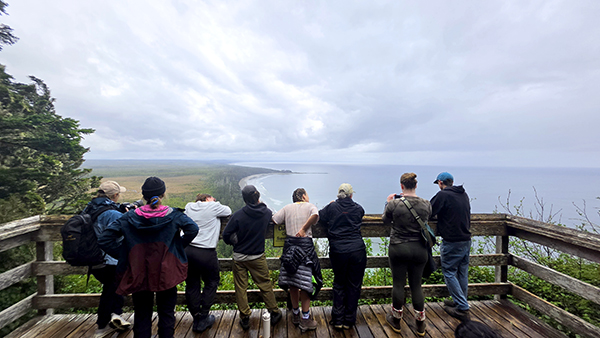
The field school group on a hike up to Tow Hill viewpoint by Old Masset on the northern tip of Haida Gwaii.
“It was really important to me that we established a deep sense of community within our tiny little group before we went into community.”
The course was designed around relationships — first within the small group of 13, then with the guides, knowledge holders, hosts and communities who welcomed them.
Arriving on Haida Gwaii, the group camped near Daajing Giids and the learning began with a day trip guided by Haida Style Expeditions to visit two village sites in Gwaii Haanas.
“Gwaii Haanas is a notable place in the tourism industry, but also globally as far as protecting places and spaces in a meaningful way. You have to have permission to go, to land at these village sites. They’re all sacred and protected, so that was a privilege,” said Orsetti, who is researching how education creates allyship and reconciliation opportunities.
“You can do all the reading, you can do all the talking, and you can try and make sense of these things. But until you get to immerse yourself in something, feel it and see it and be on the land … for a lot of these students, that was like, oh, wow. We’re here. This is real life.”
A seat at the table
During a private tour of the Haida Heritage Centre, a Haida youth guided students through stories connected to the monumental poles on the property, bringing history and culture to life. In the centre’s carving shed, Haida artist Garner Moody happened to be at work on poles scheduled to be raised later this summer. Students were invited in, and the artist welcomed questions as he carved, creating an unexpected opportunity for conversation and learning.
Orsetti had scheduled tours and facilitated sessions throughout the course, including the Tluu Xaada Naay Society canoe carving shed which students visited later in Old Massett. But again and again, the learning unfolded through invitations — into living rooms, kitchens, community spaces and conversations students could not have accessed on their own.
Food became central to that learning. At Keenawaii’s Kitchen in Skidegate, Elder Roberta Olson welcomed the group into her home for a multi-course meal prepared with locally foraged, harvested and caught foods. Other offerings appeared throughout the trip: canned salmon delivered to their campsite, jam made from local berries, deer from a local hunter, dried seaweed and k’aaw, a herring roe delicacy.
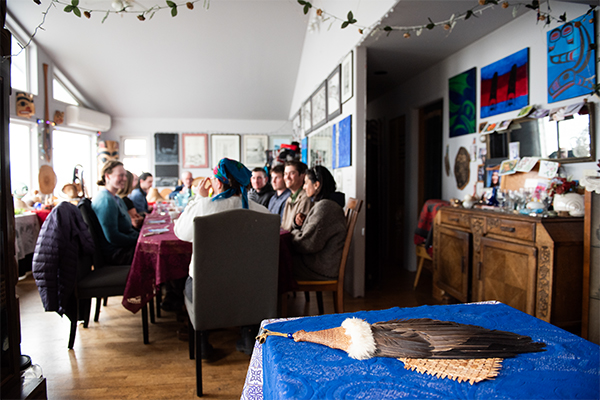
At Keenawaii’s Kitchen, Elder Roberta Olson opened her home, sharing stories and a multi-course meal of locally-sourced food.
Student Unaysah Ladhani said the field school taught her things she could never have learned in a classroom, from adapting to living and learning with the group, to embracing experiences far outside her comfort zone.
“From using an outhouse and seeing a bear and a fox in the wild, to eating new foods and camping under the night sky with people who had been strangers only three months before, the trip gave me unforgettable firsts and lessons about connection, resilience and openness,” she said.
The field school’s most powerful lessons came when the group was unexpectedly invited to help prepare for a memorial potlatch — and then to attend. Students served soup, learned dances and took part in the celebration of life for a matriarch and Elder. Not something Orsetti could have planned, it happened because of relationships, trust and the willingness to say yes when community members invited them in.
The final day brought one more moment of unexpected witness. At North Beach where the group was camped, community members gathering for a ceremony at sea to spread the Elder’s ashes once again welcomed them.
“We all left a little shell shocked, to be honest,” Orsetti said. “It was a lot to process those last few days.”
Back on the ferry and the long road to Kamloops, students reflected on what they had seen, heard and been trusted to participate in. One student said, “Maybe reconciliation is about returning home.”
For Orsetti, it captures the deeper purpose of the field school: learning that begins with place, but does not end there.