
Soil may look quiet on the surface, but beneath it is a complex ecosystem that can reveal early signs of environmental change. A Thompson Rivers University researcher is studying how microscopic life in soil could help support land management decisions across BC.
Dr. Yue Zhang, an assistant professor in TRU’s Department of Mathematics and Statistics, specializing in statistical modeling and machine learning applied to genomic data, is part of a multi-sector research project examining soil biodiversity across BC. Funded by Genome BC through its Policy and Research Innovation Lab (PRIL), the initiative brings together researchers, Indigenous Nations and land stewards to better understand how soil microbial communities support ecosystem health and resilience.
While forests, crops and wildlife are often the focus of environmental decision-making, much of what sustains these systems happens underground. Bacteria and fungi work steadily beneath the surface, helping plants access nutrients, maintaining soil fertility, storing carbon and supporting recovery after disturbance.
Making the invisible visible
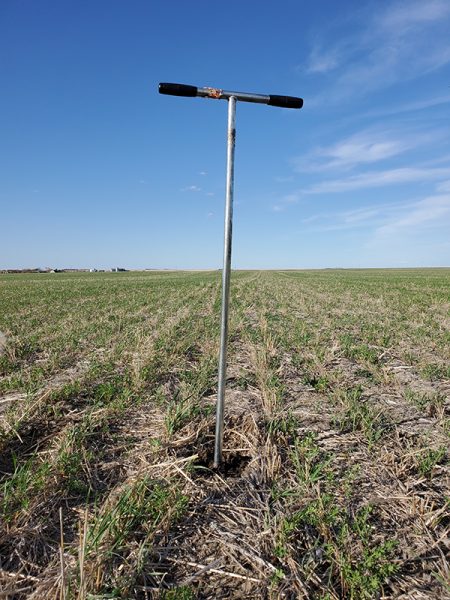
A soil corer in a field site, used to extract soil samples for biodiversity and composition analysis. Photo credit: Dr. Zelalem Taye.
The project uses genomic analysis, which examines the DNA of organisms living in the soil, along with data science and machine learning to better understand microbial life underground. The findings will be made accessible through a user-friendly website and the work is designed to align with the goals of the Kunming-Montreal Global Biodiversity Framework.
Within the project, Zhang’s contributions span both the analytical and communicative sides. She applies statistical methods, genomics and machine learning to make sense of complex soil datasets and is building a user-friendly website to bring the findings to researchers, land managers and Indigenous communities.
“From my perspective, genomics changes the type and scale of data we can work with,” said Zhang. “Instead of a few soil measurements, we now have very high-dimensional data that captures microbial patterns in much more detail. Statistical and machine learning methods allow us to find meaningful patterns within that data and build models that can support monitoring and decision-making.”
By identifying patterns in these datasets, the team hopes to develop tools that allow soil biodiversity to be monitored more consistently and incorporated into environmental decision-making.
At the same time, Zhang emphasizes that data alone is not enough, findings need to be interpreted alongside real-world conditions on the ground. The project also works alongside another Genome BC-funded research group to jointly manage and organize data, contributing to a broader, coordinated effort to protect and track biodiversity across the province.
“Genomics gives us data, and data science helps turn that into usable knowledge,” Zhang said.
Detecting ecosystem stress earlier
One reason the research matters is that changes in soil ecosystems can act as early warning signals for environmental stress.
Because soil microbes respond quickly to changes in conditions, they may reveal problems before visible signs appear above ground.
“People naturally focus on what they can see, like trees, wildlife or crop yields,” said Zhang. “But microbes respond quickly when ecosystems are under stress. If we’re not paying attention to that, we can miss early warning signals and end up reacting only after problems become visible.”
By building data-driven indicators of soil health, the project aims to help land managers detect ecosystem changes earlier and respond more effectively.
Working with Indigenous Nations and land stewards
The project also emphasizes collaboration with Indigenous Nations and local land stewards, who are involved in shaping how the research is conducted and how the findings may be used.
Indigenous partners help guide where soil samples are collected, what questions the research explores and how results are interpreted in the context of land stewardship.
“Indigenous Nations are partners throughout the project and help shape where we work, what questions we ask and how results are interpreted,” said Zhang.
This collaborative approach also includes designing data tools and workflows that respect Indigenous data governance and support community priorities.
Training the next generation of researchers
The project is also creating research opportunities for students.
TRU data science master’s student Hadiseh Azadehyaei is contributing to the work by analyzing large-scale soil DNA datasets to better understand how microbial communities can indicate soil health. Her research supports the broader goal of developing tools that can help monitor soil biodiversity and ecosystem change.
“Working with large-scale soil DNA data lets us see patterns across microbial communities that we’d miss if we looked at individual species,” said Azadehyaei. “By combining ecological analysis with machine learning and deep learning, we can connect those patterns to soil properties to identify microbial indicators that signal soil health.”
Her work examines patterns across thousands of microbial species and links them to soil characteristics such as pH and carbon levels.
Listening to what soil can tell us
For Zhang, the research highlights an often-overlooked reality: soil ecosystems are living systems that continuously reflect the health of the environments above them.
“Soil is not just dirt,” said Zhang. “It’s a living system filled with microscopic life that reflects the health of the ecosystems above it. By learning to interpret those signals, we can gain earlier insight into how landscapes are changing.”
As researchers continue to unlock the signals hidden within soil ecosystems, the information beneath our feet may become an increasingly valuable tool for sustaining forests, farms and landscapes across BC.