Sun Peaks Mountain Resort Municipality is trying a new approach to reduce wildfire risk in the forests surrounding the community — and Thompson Rivers University (TRU) is right in the middle of it.
Instead of piling leftover wood and brush from fuel-reduction treatments and burning it when conditions allow, crews are now chipping and mulching the debris and spreading it in a thin layer across the forest floor to decompose naturally. The pilot project, funded by the Forest Enhancement Society of BC since 2023, aims to lower wildfire hazard, reduce smoke and carbon emissions, and improve the long-term health of these high-elevation forests.
“This project shows what can be done when municipalities, universities and the private sector get together to come up with innovative ideas to address current and future wildfire risks to communities,” says John Karakatsoulis, associate teaching professor in TRU’s Faculty of Science.
Community under pressure
Sun Peaks sits in a high-risk wildland-urban interface (WUI), surrounded by volatile coniferous forests. As residential, tourism and recreational development continues, the WUI expands — along with the need for year-round strategies to manage forest fuels.
Fuel-management work such as thinning smaller, lower-level trees has been part of the resort’s wildfire risk program since it was established. But because these treatments don’t generate large volumes of sellable timber, hauling small amounts of leftover fibre to mills isn’t economical.
The result: a lot of residual debris with few practical options for disposal.
Burning limits
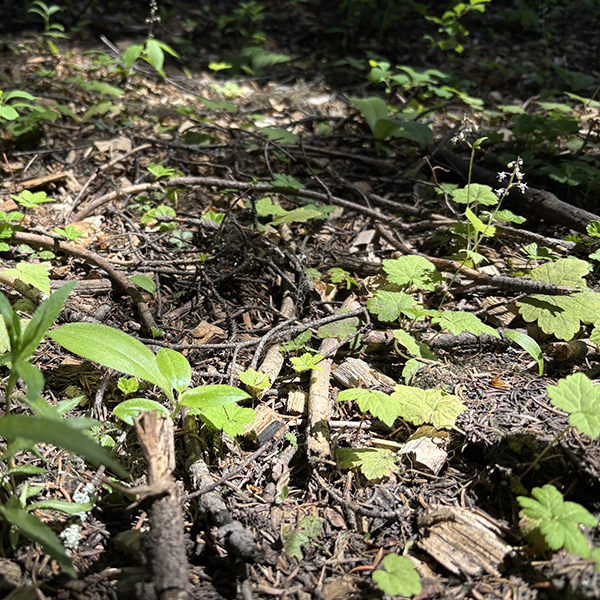
Leftover wood and brush from fuel-reduction treatments is chipped and mulched — called mastication — and spread in a thin layer across the forest floor to decompose naturally. Leaving organic material on site keeps nutrients cycling in place, can enhance soil organic matter, and helps soils retain moisture.
Forsite Consultants Ltd. — now part of Barr GeoSpatial Solutions Company — has been working with Sun Peaks to find alternatives as the burning window shrinks every year. Kyle Gillich, a Forsite consultant and TRU alum who completed a Bachelor of Natural Resource Science and a master’s in environmental science, said the pilot is designed to give the community a more practical and sustainable way to deal with forest debris.
“Mastication is the technical term that includes chipping and mulching of debris,” he explains. “It’s basically the mechanical breakdown of woody debris into smaller pieces, which we then disperse uniformly on the forest floor in a thin layer to naturally decompose.”
The shift is driven in part by how hard it has become to rely on burning.
“In the Sun Peaks area, we’ve only had about seven to 14 viable burning days per year,” says Gillich. “Fire bans are lasting later into fall, venting conditions at high elevation aren’t always there, and there’s increasing concern about smoke and air quality.”
Gillich says the growing constraints have left Sun Peaks with piles accumulating for years at a time, creating both operational headaches and potential hazards.
Pilot goals
The pilot is about giving Sun Peaks a reliable, lower-impact tool for managing forest fuels.
“In simple terms, we’re testing whether chipping and mulching debris on-site can replace pile-burning,” says Gillich. “It’s important because Sun Peaks needs treatment methods that can actually be carried out consistently under today’s fire bans, smoke regulations and community expectations.”
He adds that the work also speaks to a bigger challenge facing many B.C. communities: how to keep up with fuel management when traditional disposal methods are becoming less viable.
Shift in practice
This isn’t simply a new piece of equipment — it’s a different philosophy about what to do with forest debris.
A review of the ecological and fire-behaviour impacts was conducted and chipping and mulching as low-carbon alternatives were proposed. That advocacy helped push for policy change and paved the way for the Sun Peaks pilot to move ahead.
Measuring the benefits
Researchers expect several kinds of benefits, and the pilot is designed to measure them over the long term.
- Ecological benefits: Leaving organic material on site keeps nutrients cycling in place, can enhance soil organic matter, and helps soils retain moisture. Previous studies in subalpine and montane ecosystems have shown moisture increases of roughly 45% and 35%, respectively, after mulch dispersal.
- Fire behaviour benefits: Moister soils and forest duff can reduce fire spread and intensity, giving treated areas more resistance during drought and extreme fire seasons.
- Economic benefits: Mastication is more feasible than transporting low-value fibre. It also avoids the narrow scheduling windows that pile-burning depends on, allowing faster treatment timelines.
- Social benefits: Most importantly for residents and visitors, mastication is smoke-free. It eliminates the ash and air-quality impacts that come with open burning — a growing concern in high-use recreation areas and resort communities.
Student-led research
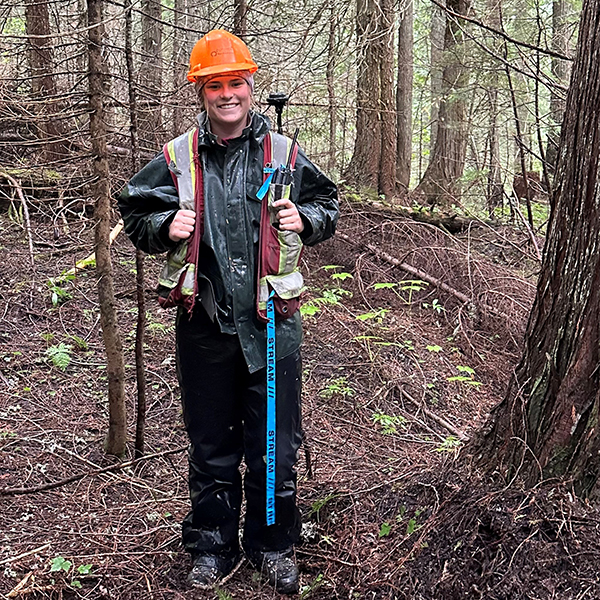
TRU Bachelor of Natural Resource Science student Kendall Smith conducted undergraduate research that is informing the pilot project.
Kendall Smith, a TRU Bachelor of Natural Resource Science student, is helping establish the scientific backbone of the project. Smith collected baseline data in 2024, capturing pre-treatment and immediate post-treatment conditions.
“The long-term project is led by Forsite, and my pilot study fits inside that,” she says.
Smith spent field days establishing permanent plots and taking measurements including tree species and height, vegetation type, woody debris loads, and chip depth and coverage. She also collected moisture and depth data for her own graduating essay research.
Beyond Sun Peaks
Smith says Sun Peaks is an ideal place to test real-world wildfire mitigation because of its extreme WUI risk, proximity to dense forests, and high infrastructure value.
“Fuel management is one of the most important strategies that communities can use to reduce wildfire impacts before a fire even starts, such as the FireSmart initiative. This project is important because it’s testing an alternative to open-pile burning, a method that, while effective, often faces public pushback.”
If mastication proves effective at lowering wildfire risk in Sun Peaks, she says, the findings could be applied to other high-risk communities across the province.
Looking ahead
In May 2024, the BC Wildfire Service changed policy to allow dispersion of masticated matter. Similar pilots have been running in Rossland and Harvey Lake, Vernon, Kamloops and Tappen.
“This change has been a catalyst,” says Gillich. “Contractors are investing in new equipment, treatments are happening at record pace, and we’re seeing healthier, more resilient forests without the smoke.”
At Sun Peaks, monitoring will continue at permanent sample plots in the coming years to track ecological, economic and fire-behaviour outcomes against pile-burning and untreated areas.
For Smith, being part of that long-term work has been both challenging and inspiring.
“Designing and executing my own sampling methods for my individual research was definitely one of the most memorable parts of the project for me,” she says. “It showed me how much research involves trial and error — but it also showed me how important this work is for communities facing catastrophic fire seasons.”
As wildfire risk escalates across B.C., the Sun Peaks pilot offers a glimpse into alternatives in fuels management; alternatives that can be faster, cause less immediate emissions, and also align with both ecosystem health and community expectations.
This project is part of TRU Wildfire, a university-wide initiative that advances research, education, training and innovation to address wildfire challenges and prepare for a more wildfire-resilient future.