
A snowshoe hare moving through the forest is doing more than searching for food or avoiding a predator. How much it moves, when it rests and how it responds to changing conditions can offer clues about the health of the animal — and the ecosystem around it.
For Dr. Emily Studd, assistant professor of biology at Thompson Rivers University, those everyday movements are a window into a much larger question: how are wildlife and ecosystems responding to a rapidly changing environment?

Dr. Emily Studd, Biological Sciences, leads the Wildlife Ecology and Behaviour Lab at TRU.
Studd’s desire to understand wildlife behaviour began while she was growing up in rural Ontario.
“I noticed that every winter our local family of North American beavers would shift from being active in the middle of the night to middle of the day,” she said. “A 12-hour shift, which is crazy and raises the question, why?”
That question — why animals change what they do — has continued to drive her research.
“I love the explorative nature and unpredictability of both scientific discovery and working outdoors with wildlife,” Studd said.
“You never know what each day will bring. The more you watch wildlife the more interesting behaviour you see, and the more questions come up.”
Those questions now extend far beyond the behaviour of a single animal. Her research examines what changes in movement and activity can reveal about the health of wildlife populations and the ecosystems they inhabit.
“Energy is the currency of life,” Studd said. “Survival only occurs when a species consumes enough energy to fuel the costs of sustaining life and evading those that want to eat it.”
Movement both expends energy and allows animals to find food and encounter other species. By tracking those patterns across days, seasons and years, Studd and researchers in TRU’s Wildlife Ecology and Behaviour Lab investigate responses to everything from daily temperature and air quality to wildfire, urbanization and changing habitat.
“Behaviour is flexible and dynamic,” Studd said. “Wildlife are able to use behaviour to buffer negative consequences of bad conditions and capitalize on good conditions.”
But that adaptability has limits. Understanding those limits could eventually provide an early warning that animals or ecosystems are under stress.
Contrasting landscapes
Interior BC offers a unique place to study how wildlife are coping with environmental change.
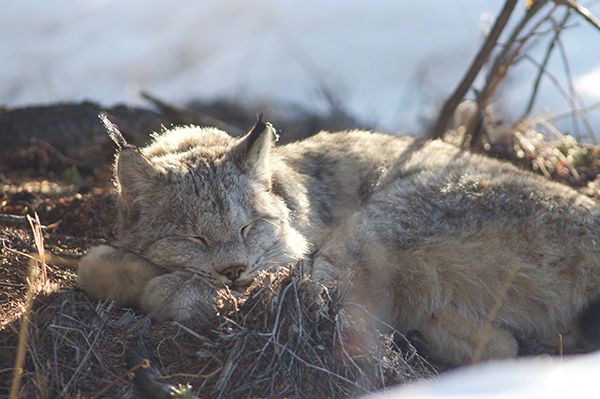
Canada lynx save energy during cold winter days by napping in the sun.
Within just 50 to 100 kilometres across the mountainous terrain, animals encounter dramatic differences in temperature, moisture, seasonality and human development. Some species already experience summer heat that pushes the upper limits of what they can survive.
Studd pairs her research in Interior BC with work in the Kluane region of Canada’s North, where researchers have intensively monitored an entire ecosystem for 40 years. Many of the same species occur in both places but face very different pressures — from Interior heat to northern cold stress and much longer periods of snow cover.
Studying wildlife across contrasting landscapes helps researchers identify which environmental pressures matter most to a species — and which findings can be applied more broadly.
“Everything in the world is connected,” Studd said.
Tracking behaviour
Technology allows her to see those connections in increasingly fine detail.
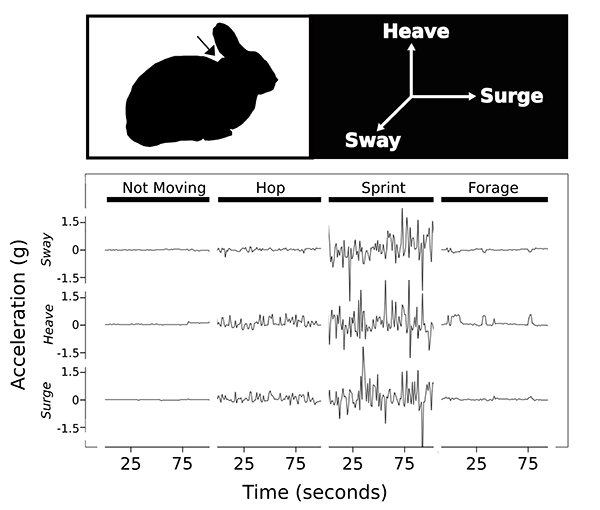
An accelerometer on a hare records a different pattern of acceleration for each behaviour, allowing researchers to track behaviour over time.
Tools including accelerometers function much like a Fitbit for wildlife. They continuously record activity, allowing researchers to observe animals without being present and potentially influencing their behaviour. Studd uses these data to identify subtle changes in behaviour as animals respond to temperature, air quality and other environmental conditions.
Studd’s research on Canada lynx, red squirrels and snowshoe hares demonstrates how the behaviour of one animal can ripple through an ecosystem.
Red squirrels alter their activity in response to temperature and food availability. When squirrels are less active, they are harder for lynx to catch, driving the predators to concentrate more of their hunting on snowshoe hares. Looking only at lynx and hares would miss the role squirrels play.
“The more you move, the more you bump into other things,” Studd said.
For squirrels, that can be deadly: the more active they are, the more likely they are to be killed by predators. Snowshoe hares show a different pattern, with predation occurring whether they are active or resting.
Those differences affect how energy moves between species and throughout an ecosystem — one reason why understanding wildlife requires looking at multiple species and landscapes together.
Responding to a changing landscape
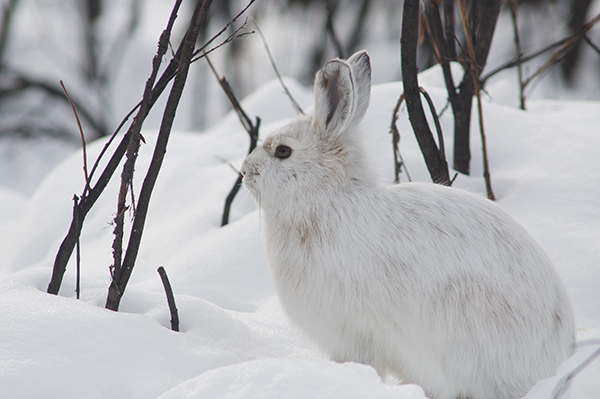
Snowshoe hares sport thick white coats in winter to save energy and blend into the snowy landscape.
While Studd’s tracking reveals how animals adjust their activity in response to daily changes in temperature, air quality and other conditions, wildfire can reshape the landscape — and the wildlife community with it.
Fire can rapidly transform plant communities, changing the food and protective cover available to wildlife. Some species may lose suitable habitat for decades while others thrive in newly burned landscapes.
“We have to expect that there will be winners and losers in the wildlife,” Studd said.
Determining which species fall into each category — and what that means for Interior BC 10, 20 or 50 years from now — remains an important research question.
Reading the early signs
Population declines can signal that something has gone wrong, but by the time they become obvious, opportunities for conservation may have passed. Behavioural changes happen sooner.
Studd’s research is building the knowledge needed to interpret those early behavioural changes and determine when they signal a deeper problem. Combined with whole-ecosystem monitoring, that knowledge could eventually give communities and land managers more time to make informed conservation decisions before a population crashes.
“If we want to make good management and conservation decisions, it is vital that we understand what these limitations are and what different behaviour is telling us about the wellbeing of wildlife,” she said.
For Studd, every answer is also an invitation to keep asking questions — including one that has stayed with her since childhood.
“I have yet to answer my original question about beavers,” she said. “Maybe one day I will, but until then I thoroughly enjoy the adventure that comes with wildlife ecology and animal behaviour.”
Studd’s work connects to TRU Wildfire, a university-wide initiative advancing research, education, training and innovation to address current and future wildfire challenges. Learn more.


Thompson Rivers University is leading in sustainability. Learn more about TRU’s contributions to the UN Sustainable Development Goals.