Haida on her mother’s side and Kwakwaka’wakw on her father’s side, Juli Holloway (BJour ’07) has turned her passion for storytelling into a career dedicated to strengthening Indigenous voices.
Today, she’s advancing conversations around Indigenous self-determination, economic reconciliation and the role of communications in creating change. But as a young Indigenous girl living in remote communities in Haida Gwaii and northern Vancouver Island, she had no idea her love of writing could become a career.
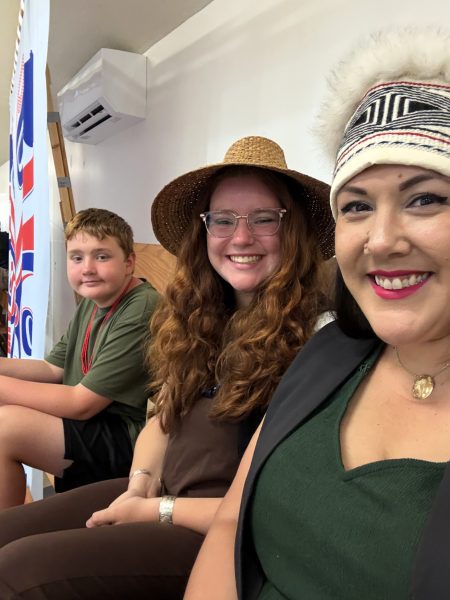
Juli Holloway (right) and two of her children, Tristan (left) and Alexis, at a totem pole raising event in Haida Gwaii.
“If you grow up in a village or remote community, you may only know about the jobs you can see. It can be hard to imagine something more,” said Holloway. “You have to be able to see it to be it.”
Her vision of possibilities began to expand during high school in Port Hardy, where she had the opportunity to participate in an award-winning journalism program that exposed her to photography, publishing, production and storytelling.
She imagined herself heading east to pursue her education after high school, but becoming a young mother shifted her plans. Holloway enrolled in a business administration program, but soon realized her strengths lay elsewhere.
“I found myself thinking, am I really going to keep trying to swim against the current, or am I going to figure out how to do something that I’m actually good at and that I really enjoy?”
The answer led her to Thompson Rivers University, home of British Columbia’s only print-based journalism program at that time. The program, which included a public relations stream, allowed her to build on credits from her previous studies while developing the skills that would shape her career. It also helped her construct a platform for the kind of storytelling she hoped to pursue, sharing positive stories about First Nations communities and people.
But as a young mother with limited resources, even applying to university wasn’t without its hurdles.
“I couldn’t even afford the $25 application fee. Thankfully, my mom helped me with that,” she said. “I sent it away and got accepted. I remember being so excited.”
Moving to Kamloops from the coast was a major step for Holloway, her young son, and partner. Far from family and cultural supports, they imagined the move being short-lived, but more than 20 years later, they are still here raising their two younger children. Their older son graduated high school after completing the dual credit trades program offered through School District 73 and TRU and is now working as an electrician.
“Before I graduated, we thought we were going to move back to the Island when I finished my degree, but I think I finished coursework on a Thursday and started my job the following Monday,” she said.
Supporting Indigenous self-determination
Since that first job out of university, Holloway has established herself as a communications leader in B.C. and beyond. Her work focuses on helping First Nations use strategic communications to support informed decision-making that advances self-determination and answers questions that create meaningful change.
“How can we use communications to form relationships and build trust with people? How do you effectively engage members who may be dealing with literacy issues or have apathetic attitudes towards participating in their nation’s decision-making processes? How can you help people not only vote yes or no when it comes time to vote, but actually make an informed decision when they’re voting?”
Holloway’s commitment to furthering her own knowledge led her to pursue a Master of Arts in Professional Communication at Royal Roads University (RRU), where her award-winning research explored how communications can support Indigenous self-determination and nation-building. She became the first of her family to earn a master’s degree.
“I didn’t set out to blaze these trails, but the places where I wanted to go, there were no trails yet,” she said.
Holloway also earned her Strategic Communication Management Professional (SCMP) credential, a globally recognized certification for senior communications leaders. In 2024, she became the first Indigenous woman to be named an IABC Fellow, one of the International Association of Business Communicators’ highest honours recognizing outstanding contributions to the communications profession.
Passing skills on to future leaders
Today, Holloway continues to create possibilities for others. In addition to consulting roles with various First Nations and Indigenous organizations, she teaches at the Tulo Centre of Indigenous Economics, where she also serves as the communications advisor, and co-teaches a strategic communication course in the program she graduated from at RRU.
 She also founded the Indigenous Communications Professional Association, a newly formed national network designed to connect, support and mentor current and future Indigenous communicators.
“We’re trying to build an association that we would have wanted when we were getting into this career 20 years ago,” she said. “I am a pretty big advocate for communications as a valuable and rewarding profession for Indigenous people.”
For Holloway, her role as a leader in communications isn’t simply about sharing information. It’s about amplifying Indigenous voices, strengthening communities and creating opportunities for future generations to lead.
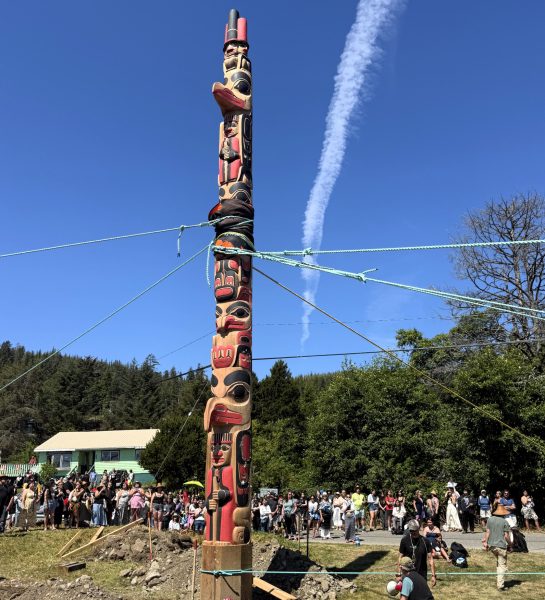
Reflecting on a recent visit home to Haida Gwaii, she spoke about the joy of witnessing cultural revitalization efforts that include the raising of three new totem poles, and seeing her children experience traditions that strengthen their Indigenous identity.
“It was only a few generations ago that our culture, language and traditions were taken from us,” she says. “To be in a space where kids are proud to be Haida, that feels pretty powerful.”