
Good food brings people together, and great mentors help mentees realize their full potential. That’s exactly what Thompson Rivers University student Akemy Earl is learning on her educational and culinary journey as a participant in a barrier-reducing pilot project in the Faculty of Education and Social Work.
This groundbreaking and inclusive pilot project ladders graduates of TRU’s Education and Skills Training (ESTR) program into the Culinary Arts Professional Cook program. Most importantly, the pilot waives the requirement of the Accuplacer test, an academic assessment that can present a barrier to candidates who are well-suited for the area of study, but require certain accommodations.
“A common barrier for students with intellectual disabilities is they’re unable to attend university because they don’t meet the academic requirements. Other post-secondary institutions attempt to include them by amending their curriculums and offering not-for-credit courses to students with intellectual disabilities,” says Saskia Stinson, ESTR Program Coordinator.
“TRU demonstrates the gold standard for EDI because young adults can apply for programs and attend classes at their own pace.”
ESTR offers education and training for people who are neurodivergent and looking for education and employment opportunities. ESTR students can earn Career Exploration, Kitchen Assistant and Retail Assistant certificates.
Practicum placement opens new doors
Earl enrolled in the ESTR program because she wasn’t quite sure what she wanted to do after high school. While in the program, she discovered she really enjoyed cooking. When she started her practicum placement at Black Salt Catering, her attention to detail, patience and work ethic made a big impression on the owner and practicum mentor, Chef Jahren Corrigan.
Corrigan saw Earl’s potential and gave a recommendation for her to TRU’s Culinary Arts Professional Cook program. Earl is currently pursuing culinary arts studies, maintaining a part-time position at Black Salt Catering and is now doing the important work of mentoring current ESTR practicum students.
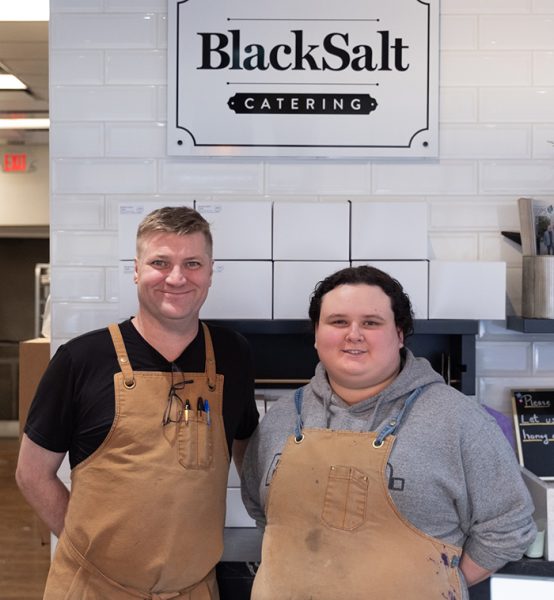
Continuing part-time work at Corrigan’s Black Salt Catering during her culinary arts program, Earl is now mentoring new ESTR practicum students.
“Everyone starts somewhere and it’s great we were able to show Akemy how to start in culinary. She’s following her dreams and it’s just wonderful. Now when we have practicum students, Akemy trains them,” Corrigan says.
Earl takes pride in her mentoring role, and knows she’s helping pass along valuable skills.
“It’s really nice, I like helping others who are starting out,” she says. “I teach them things like the recipes, knife skills, and safety protocol. I like to train people. I am able to help others with new work skills because those are sometimes life skills they can take down the road with them.”
Corrigan has nothing but praise for what Earl brings to the table.
“Akemy is very consistent. She makes things exactly as the recipes say, and from a chef’s standpoint that makes a big difference. She’s a very valuable member of our team.”
Earl’s commitment to quality and detail benefits all team members at Black Salt, not just her mentees. Corrigan says a longtime staffer was inadvertently putting too much cheese in the wraps. Earl noticed, informed them of the error and the staff member was able to correct the mistake.
Cooking with purpose and paying it forward
Looking ahead, Earl wants to finish her training, become a Red Seal Professional Cook, and travel the world — tasting new dishes and picking up unique recipes along the way.
“Everyone’s recipes are different and I want to try food from all around the world. I want to learn the different spices, techniques and flavours,” she says.
As for students who might be thinking of enrolling in ESTR, but are unsure if it’s a right fit? Earl’s advice is to “go for it.”
“Take a leap of faith, explore and see how it goes. If you’re unsure, always ask for help. It might seem very nerve-wracking and scary, but it gets easier as you go.”
Beyond this official pilot project linking ESTR to Culinary Arts, ESTR alumni can also access less formal laddering options into various TRU programs. Stinson has supported other ESTR alum in continuing on to study in areas like psychology, early childhood education, fine arts, theatre and computer science.
“ESTR introduces them to the world of work, or to other programs at TRU. We support them however we can along the way. The world is changing and it’s really nice to see. There are a lot more opportunities now for people who are neurodivergent. Working with those young people can change you — they are so inspiring,” Stinson says.
And for any business interested in joining the more than 40 organizations that offer practicum placements for ESTR students, Corrigan can’t recommend it enough.
“It’s a great program to get involved with. I continue to do this, because of the young people coming through — it’s my way of paying it forward. They are enthusiastic about cooking and it’s nice to see people interested in what they are doing, even if they don’t have much experience. I’d rather mentor someone like that, who has the willingness to learn.”
For more information on ESTR or to become a practicum host, visit the program website.