
On November 19, students in Thompson Rivers University’s (TRU) Faculty of Law First Nations Governance and Economic Development class got a firsthand look at Indigenous-led business. Troy Young, a prominent Indigenous entrepreneur and owner of the Roga Group of companies, delivered a wide-ranging presentation on Indigenous business, economic development and the intersection of Indigenous self-governance with business interests.
Young, whose companies operate across the civil works sector, spoke candidly about the challenges and opportunities facing Indigenous-owned businesses. Drawing on his experience working with communities across Western Canada, he emphasized the value of strong leadership and the importance of “brain power” — the employees who drive a company’s success.
He also gave students an inside perspective on the complex and often contentious process surrounding construction of the Coastal GasLink pipeline, a project in which Indigenous business participation played a significant role. Young discussed everything from community engagement before and during the project to construction logistics.
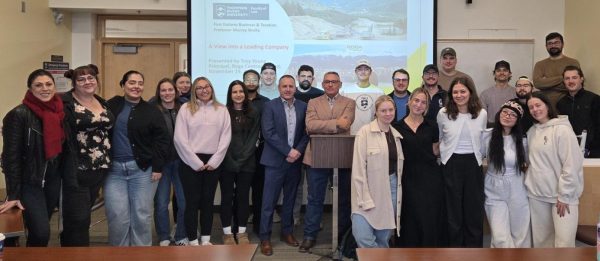
TRU law’s First Nations Governance and Economic Development class with guest speaker Troy Young (centre)
TRU professor Murray Sholty welcomed Young’s contribution, noting the value of hearing directly from someone who has been at the centre of major Indigenous-industry initiatives.
“Troy’s presentation gave students an inside look not only at an Indigenous-led business but also crucial insight into important recent events, including the construction of the Coastal GasLink pipeline,” said Sholty. “For students studying governance and economic development, this kind of grounded, real-world experience is critical.”
The presentation aligned closely with the course’s broader goals of preparing future lawyers to work effectively with Indigenous clients and communities. By outlining both the opportunities available to Indigenous entrepreneurs and the structural barriers that persist within government and industry frameworks, Young offered students a realistic but optimistic outlook on the future of Indigenous economic development.
Third-year law student John Hawthorne, who also serves as a teaching assistant for the course, said Young’s focus on community-specific leadership and services resonated with the class.
“Mr. Young’s presentation was fantastic. His focus on leadership and providing services tailored to each specific community was extremely interesting, and we appreciate him taking the time to speak to our class,” said Hawthorne. “He very helpfully contrasted his experiences working with different communities that have different resources and assets, and that face different obstacles. His insight was extremely valuable.”
Young’s visit was one of several guest lectures planned throughout the semester to expose students to the practical realities of working with Indigenous governments and organizations. Sholty said the sessions help bridge the gap between academic study and the complex, evolving landscape of Indigenous-industry relations in Canada.