
Thompson Rivers University’s Bee Campus initiative has a new, highly visible feature: a series of large interpretive signs installed across campus to make pollinator habitat more visible and accessible.
Installed in early December, the signs highlight education and research related to native pollinators. Led by the TRU Pollinators’ Committee, the project brought together local community members, Indigenous students, and multiple faculties and schools.
“Six unique signs are now distributed across campus in support of native pollinator education,” says Dr. Courtney Mason, committee chair and coordinator of Bee City Canada reporting for TRU.
“This project is a great example of teamwork across faculties and highlights the advantages of engaging with a dual-sector research university.”
Placed along pathways and near naturalized areas, the signs explain why pollinators matter, how native plants support them, and how Indigenous stewardship practices contribute to healthier habitat. Illustrated panels feature native plants, bees, butterflies and birds commonly found in the region, with plain-language explanations of how these species interact.
Trades students bring pollinator project to life
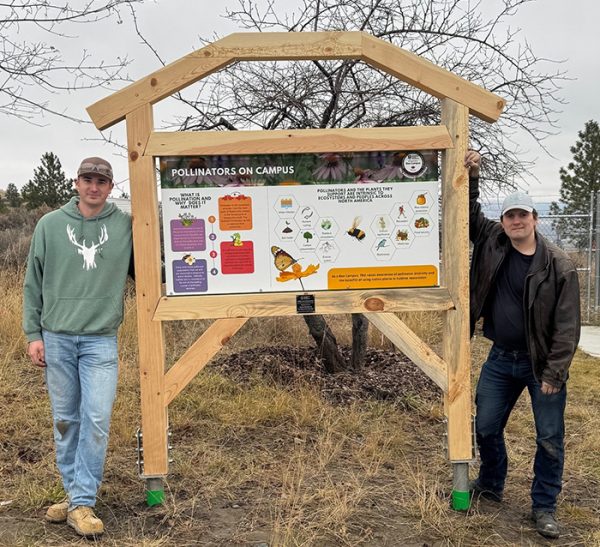
Carpentry students Curtis Behnke and Ty Haywood-Farmer at the campus orchard with their timber-frame sign — Why pollinators matter.
Hands-on construction support came from students and faculty in TRU’s carpentry program. Students coordinated by carpentry instructor Greg Alm designed and built the timber frames — made from campus trees removed during construction of TRU’s new Indigenous Centre — as part of their Level 4 Carpentry course.
“Our students are happy to leave a lasting, beautiful project on our campus while gaining credits in their course,” says Amie Schellenberg, committee member and a chair at the School of Trades and Technology.
“This is such a great example of the benefits we can leverage as a university with a trades school. We are grateful to be able to contribute.”
Recognition — and responsibility — as a Bee Campus
TRU was recognized by Bee City Canada as a Bee Campus in 2024 — a designation that connects the university to a national network focused on supporting native pollinators through habitat and education.
“We achieved the Bee Campus designation as a recognition of the work we have already done in this capacity but also our responsibilities to enhance our programming and protect pollinators on our campus and in our city,” says Mason.
“Globally there is a massive decline in biodiversity,” he says, noting British Columbia is Canada’s most biodiverse province and the Interior contains numerous threatened ecosystems.
“Native pollinators support food systems that are critical for our sustenance, our economies and our well-being.”
The new signage shows how education, place-based design and coordinated campus action can support pollinators and broader ecological health at TRU.
From signage to habitat action
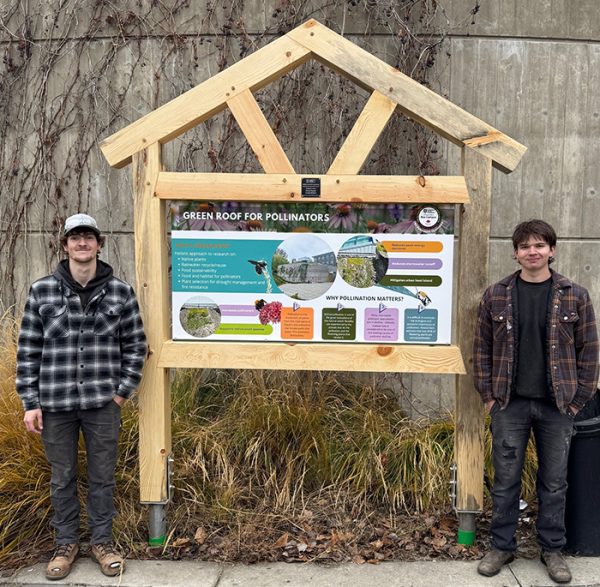
Carpentry students Chris Fisher and Mat Wilden at the House of Learning with their sign — A green roof for pollinators.
In addition to the signage, TRU is also integrating pollinator conservation into broader infrastructure upgrades and planning tied to its carbon-neutrality goals, including protection of designated natural areas and a “non-intervention” approach in key spaces.
James Gordon, director of TRU’s Sustainability Office, says the university will introduce no-mow zones on campus in the spring as a way to let native plants reestablish themselves, as well as planting native species around campus buildings.
“These plants will provide food for native pollinators and typically require less irrigation than a conventional lawn,” says Gordon.
Gordon says supporting pollinator conservation reflects TRU’s broader sustainability leadership.
“Real sustainability requires us all to get engaged and learn about the many facets of sustainability, like the importance of native pollinators. These signs will facilitate this learning, which will hopefully lead to greater engagement.”
The project illustrates the ways TRU is leveraging its strengths as a dual-sector research university, where applied learning and community-based projects intersect with sustainability and research activities.
The TRU Pollinators Committee includes: Courtney Mason, chair, Natural Resource Science/Tourism; Adam Florence, Culinary Arts; Christhina Florez, Master of Science in Environmental Science student; James Gordon, Sustainability Office; Rob Higgins, Biology; Crystal Huscroft, Geography; Elise Menard, Horticulture; Catherine Ortner, Psychology; Shay Paul, undergraduate student, Arts; Amie Schellenberg, Trades.