As wildfire seasons grow longer and more intense in B.C., Thompson Rivers University (TRU) is launching a research project to find out how homes can be built to better withstand fire.
Backed by a BC Hydro grant focused on enhancing Sustainable Construction Training for more efficient buildings through summer 2027, the new burn unit will expose real-world exterior materials — such as siding, flashing and sealants — to extreme heat. The results will help TRU integrate clear, practical, research-informed lessons for carpentry and other trades students who will be building homes in the years ahead.
Amie Schellenberg, co-chair of the School of Trades and Technology at TRU, said the project makes sense given TRU’s dual-sector research university mandate and a push toward sustainable, climate-ready construction. By turning wildfire risk into real-world, use-inspired research and teaching, TRU hopes to support safer building choices for homeowners and communities across B.C.
“This burn unit starts making sense as soon as you start talking about climate-resilient buildings,” said Schellenberg.
How it started
The idea for this project took shape after TRU carpentry instructor Greg Alm connected with James Borget of RDH Building Science at a conference. The two started trading ideas about how to bring more building-science testing into trades training.
Schellenberg said the partnership fits well with RDH’s habit of rethinking standard building practices and TRU’s goal of strengthening sustainable, climate-ready construction training.
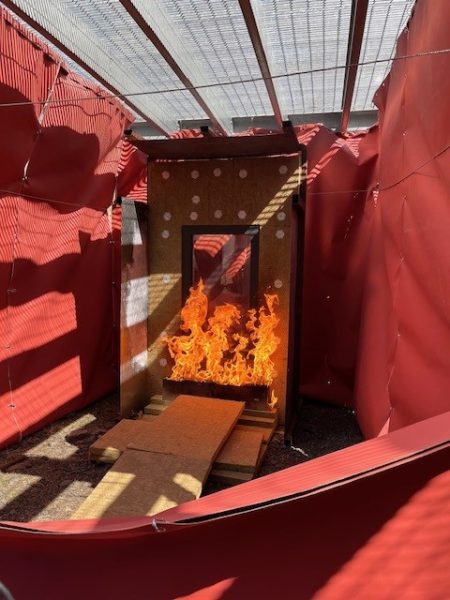
Inside the burn unit’s test chamber, samples of various exterior components are exposed to a steady, high-heat flame to see how quickly they ignite and where they fail.
Built to burn (safely)
The burn unit, housed at Kamloops Fire Rescue’s Training Centre, is contained inside a walled perimeter. Propane lines feed a steady, high-heat flame into a test chamber, where small samples of exterior assemblies are placed. Instead of torching an entire structure, researchers burn pieces of siding, detailing cutaways, sealant systems and other exterior components to see how long they last, how quickly they ignite and where they fail.
Just as importantly, the testing looks at how materials are installed, not only what they’re made of.
“You can use the proper materials, but if they’re fastened incorrectly or installed in the wrong order, they’re going to be completely ineffective,” said Schellenberg.
Why it matters
For Schellenberg, the project isn’t abstract. She lives in a rural area, has been evacuated during wildfire seasons, and said the growing risk across B.C. makes practical, tested building decisions more urgent than ever.
“If I knew what I know now during my home’s construction, I would be making different decisions about the materials on the exterior,” she said, recalling how close the Rossmoore fire came to her home in 2021.
She wants trades students to leave TRU thinking about fire resistance early — when choices are still easy to implement and affordable to change.
“They are going to be our next generation’s contractors, some of them already are,” she added. “This is giving contractors and homeowners something to consider when speccing homes and suggesting what materials to use.”
For Schellenberg, the bigger payoff is giving builders guidance they can trust, not just best guesses.
“Given where we’re at now, how can we not be thinking about fire resistance?” she said. “This testing lets us make informed choices instead of guessing — and it’s always better when those choices are backed by research.”
While the unit could eventually be used hands-on by students, Schellenberg said the first phase will be research-led, with findings brought back into shops and classrooms through videos, demonstrations and step-by-step resources.
“We need real testing to prove what works and what doesn’t,” she said. “The baseline today is Step 3 construction for energy-efficiency standards, but what about tomorrow? What can we do that’s better than that — that considers increasing energy efficiency and provides fire protection? And can we get there without a huge price tag?” (Step 3 refers to the BC Energy Step Code).
Ultimately, by testing materials and construction details under controlled fire, TRU aims to move ideas from the shop floor into credible, research-backed guidance for the building sector.
“The goal is simple,” Schellenberg said. “Test what works, teach what matters and help builders raise the bar on fire-resilient construction.”
This project is part of TRU Wildfire, a university-wide initiative that advances research, education, training and innovation to address today’s wildfire challenges and prepare for a more wildfire-resilient future. Learn more.
Thompson Rivers University is leading in sustainability. Learn more about TRU’s contributions to the UN Sustainable Development Goals.