This summer, Thompson Rivers University’s Kamloops campus became a meeting place for students, educators and partners from around the world, as the International Training Centre (ITC) welcomed close to 300 learners from Mexico, China, Mexico, South Korea, Taiwan and Japan for short-term, non-credit programming.
From language learning and professional development to cultural exchange and hands-on experiences rooted in place, the season reflected the growing role of short-term programming in connecting global learners with TRU, Kamloops and Secwepemcúl’ecw, the traditional and unceded territory of the Secwépemc.
“These programs are often students’ first experience with TRU, with Kamloops and sometimes with Canada,” said Baihua Chadwick, vice-president students and global engagement. “They create meaningful pathways for learning, partnership and connection, whether a student is here for a few days, two weeks or a month.”
Delivered through the ITC, TRU’s short-term programs are designed for groups and learners seeking focused, flexible experiences outside traditional credit programming. Programs may include English language development, career and professional skills, cultural activities, recreation and customized learning shaped around partner needs.
This year’s summer programming required significant coordination, from visa approvals and travel timelines to last-minute changes. The result was a busy, energetic season that brought new voices, languages and perspectives to campus. Two programs placed particular emphasis on Indigenous cultures, knowledge and connection across communities.
From July 16 to 19, TRU welcomed 20 students from Taiwan, ages 15 to 18, many of whom are Indigenous. Delivered in collaboration with the Coquitlam School District and the Taiwan Ministry of Education’s Global Pathfinder’s program, and supported by TRU’s Indigenous Education team, the program included a welcome and smudge with Elder Colleen Seymour, a plant walk with Marie Sandy, a visit to the McAbee Fossil Beds and time at Cplul’kw’ten, TRU’s Gathering Place. The experience created space for students to learn about Secwépemc culture and history while reflecting on Indigenous identity, knowledge and community in a global context.
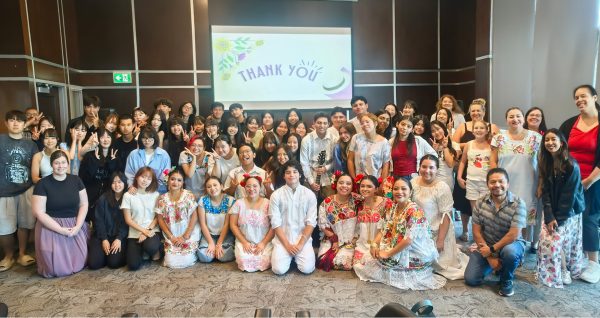
Students from Japan, Korea, Taiwan and Mexico at TRU for the July Language and Culture Program gathered for a cultural presentation and performance by the Yucatán group.
Later in the summer, TRU hosted a two-week pilot program for 13 students from Yucatán, Mexico, along with two government representatives. The students are recent high school graduates who came to TRU through scholarship support that makes international travel and study possible for high-achieving students who may not otherwise have had the opportunity. The Yucatán group focused on English for professional success and participated in cultural and experiential learning activities. The program offered practical language development and a broader introduction to life on a Canadian university campus. While here, the students gave a cultural presentation, teaching other students about traditional Mayan culture that is prevalent in Yucatán.
As international education continues to shift, short-term and customized programming is becoming an increasingly important part of TRU’s global engagement. These programs give partners a flexible way to connect with the university, while giving students a meaningful experience that can inspire future study, mobility and collaboration. They also add vibrancy to campus during the summer months, creating opportunities for students, faculty, staff and community partners to learn from one another and making global learning visible and tangible at TRU.
Thompson Rivers University is leading in sustainability. Learn more about TRU’s contributions to the UN Sustainable Development Goals.