
On Nov. 24, students in Thompson Rivers University Faculty of Law’s Truth and Rebuilding Canadian Indigenous Legal Relations class were privileged to host the Chief Justice of the Courts of Appeals for British Columbia and the Yukon, the Honourable Leonard Marchand, for his thoughts on “Reconciliation from the Bench.”
Justice Marchand touched on three themes during his presentation to students: first, a progress report on how Canada is doing implementing the Truth and Reconciliation Commission (TRC)’s Calls to Action; second, an inside look into the BC Court of Appeal’s reconciliation efforts; and third, his perspective on what the court’s public outreach and community engagement strategies should be.
Ten years after the TRC Calls to Action were released, the picture remains grim in important areas, Marchand said. Despite an overall drop in Canada’s incarceration rates, he told the class, Indigenous overrepresentation in federal prisons has increased. The crisis in Indigenous child welfare is equally stark.
“Is it any wonder we have such large socioeconomic gaps?” he said, linking today’s disparities to historic dispossession of land, residential schools, and systemic racism that left families “devastated by the loss of what brought them most joy: their children.”
Yet there are positive signs, as well. A self-described optimist, Marchand depicted the BC Court of Appeal’s own reconciliation efforts as modest but deliberate and impactful. The court is expanding community outreach (with stops in Hazelton, Smithers, Tsawwassen, and Kelowna to date); mandating ongoing education on bias and trauma-informed practice; reviewing the court’s internal hiring procedures; and incorporating First Nations art and ceremony into proceedings where possible.
“We are very grateful for Justice Marchand’s time and wisdom”, Professor Murray Sholty said. “All of the students left the session better informed about reconciliation and the court’s role in it than they came.”
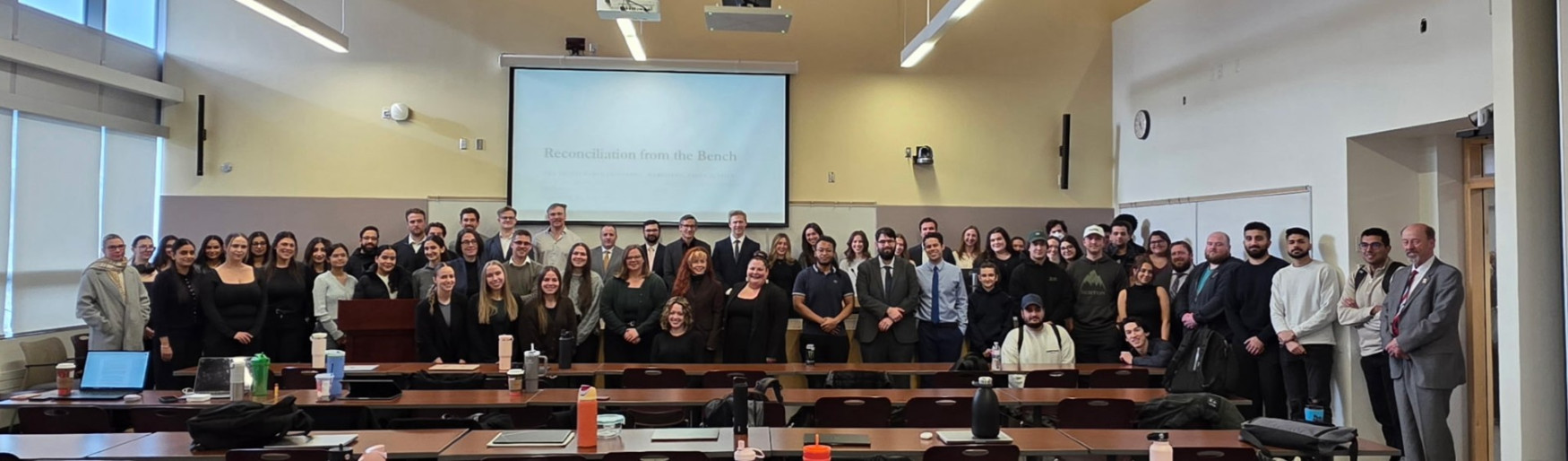
Chief Justice Marchand and TRU Law students and faculty at a November 2025 presentation.
Building trust through community engagement
Speaking to fears that increased judicial interaction with select communities will erode independence, Marchand said community engagement “bolsters rather than diminishes judicial independence.”
And whether they want to or not, he said, courts remaining silent is no longer viable in an era of eroding trust and dying local court reporting.
“The days of the dedicated courthouse reporter are over,” he noted, leaving courts vulnerable to misunderstanding. He praised the Provincial Court of British Columbia as the “gold standard” for public communication while acknowledging risks: some now see Marchand personally as the court’s voice and approach him with grievances he cannot resolve.
“Justice Marchand’s presentation was incredible,” said second-year law student Henry Stagg-Tanner. “His insights into reconciliation from his perspective were invaluable.”
“It was amazing to get the exposure to Chief Justice Marchand’s thoughts on reconciliation,” second-year student Andrew Kemp said. “His perspective is fundamentally different from that of a student, lawyer or professor, and it was incredible to listen to his presentation.”
“Reconciliation is in large part about repairing relationships,” Marchand concluded. Despite the setbacks, he remains optimistic that Canada’s justice system can still learn and improve by meaningfully incorporating Indigenous legal orders.
“Let’s not get discouraged,” he urged the future lawyers in the room, “as we try to bring our social fabric together.”