
Nada Abdelghaffar, a journalism student who lives with visual impairment, understands the tenacity required to navigate the many structural, ethical, attitudinal, and bureaucratic obstacles people with disabilities or medical conditions face.
Coming to Canada for the first time in winter 2017, Abdelghaffar was thriving in her student life.
“I love Kamloops. It’s a nice, small, friendly town. There’s a familiarity to it. I’ve gotten to know instructors, staff, and other students. It feels like home to me. That’s a good feeling.”
In 2019, she famously asked then-Prime Minister Justin Trudeau about accessibility priorities in the government sector in a packed assembly at TRU.
Changing course without a choice
When COVID collided with some health challenges relating to the congenital glaucoma she was born with.
Her mother, Nadia Khalifa, who had previously been a travel companion, tried multiple times to reunite with Abdelghaffar but couldn’t overcome the travel restrictions.
Abdelghaffar returned to Cairo reluctantly.
“The pandemic was a shock; it was a confusing time. Being withdrawn from people made me withdraw from everything.”
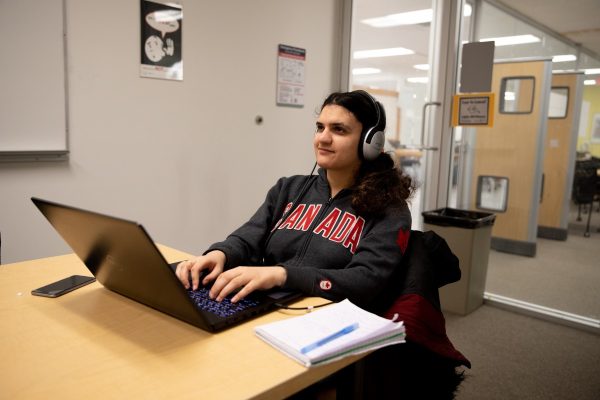
Abdelghaffar makes the most out of student life at TRU.
During the global lockdown, Abdelghaffar worked remotely but found the job search experience, interview processes, and hiring practices problematic and non-inclusive.
“It was a challenge to find a job. Many companies rejected me for using a screen reader or for perceived limitations. One instance that really hit hard was when I was applying for a job, the recruiter told me to try to pretend that I could see instead of disclosing my visual impairment.
Those interactions chipped away at Abdelghaffar’s confidence at a time when her world felt increasingly contained. Upon her post-pandemic return to Kamloops, Abdelghaffar was grappling with social anxiety; luckily, her mother was able to accompany her to help her re-establish herself in her next chapter at TRU.
A unique relationship
Khalifa and Abdelghaffar were a well-known duo on campus.
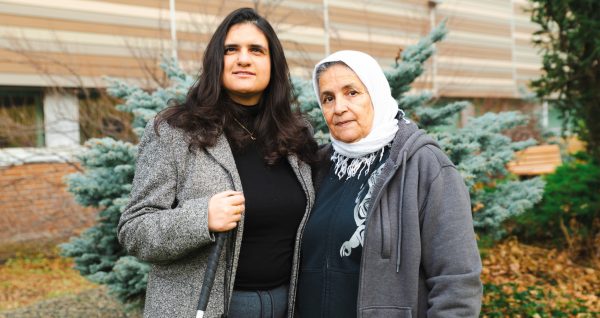
Abdelghaffar (left) with her mother, Nadia Khalifa (right).
“I was afraid to meet new people and face everyone again, but having my mom with me made all the difference.”
In a conversation with the two, Khalifa speaks at length only when Abdelghaffar encourages her, asking her to share recipes for her most beloved dishes.
After sharing insights into her cooking with quiet humility, she also played clips of Abdelghaffar competing on a student edition of an Egyptian gameshow on YouTube, beaming with pride.
Khalifa did not attend classes, and while she’d walk alongside her in the halls, she’d rarely intervene, ensuring that Abdelghaffar was making her own decisions and finding her own way.
She returned to Cairo around the midway point of the winter semester, once Abdelghaffar had settled in Residence.
While she regretted leaving, she was looking forward to getting home to the family dog.
On-campus support systems
Abdelghaffar cites a favourite instructor, Dr. Charles Hayes, former AVP/Dean of the Faculty of Student Development, Chris Adam, and Multi-Faith Chaplain Jeff Torrans as part of her support network.
“Jeff is such a kind, bright man. Chris was always a good point of contact; she was never judgmental and didn’t push for answers. When I first came back to TRU, Dr. Hayes met me at Starbucks, even though he’s retired. It’s nice connecting with instructors outside the classroom; you don’t need to be actively taking a course to be able to stay in touch.”
“I’ve known Nada since she first arrived on campus”, said Adam, now an instructor at TRU. “The most powerful time I’ve spent with her was when she visited my second-year communication class last semester. The students were the most fully engaged I had ever seen them, as they asked her questions about how she navigates the campus, Moodle, and academic life. Her generosity and authenticity shone through, and they often referred to her visit in future assignments.”
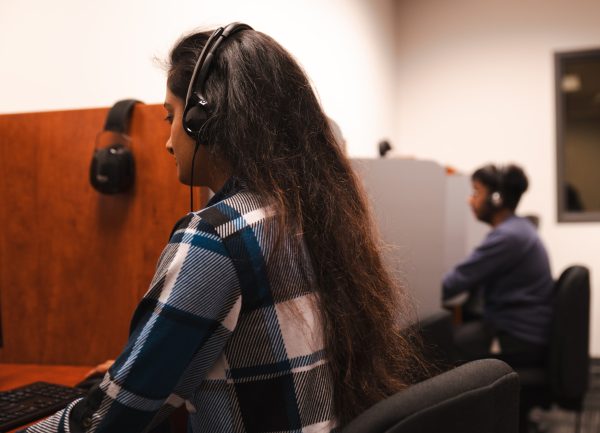
Accessibility Services promotes assistive technology and provides access to a Test Centre for students with accommodations.
Building a digital community
While person-to-person, real-time connections are part of Abdelghaffar’s value system, she also enjoys a rich online existence.
“I’ve been an ‘online person’ since the age of 13, starting with Facebook, to evaluate accessibility features. I was fascinated. The world is so big, and internet access widened my perspective and expanded my opportunities.”
Abdelghaffar developed many of her first formative friendships online.
“I’m an extrovert, but I struggled to make friends in school. The class would go out together on the last day of exams, without extending an invitation. They’d talk about it in front of me, as if I wasn’t there.”
While exclusion is painful and harmful, Abdelghaffar doesn’t let it deter her or distract her from her highest purpose.
“Go show your face; if people don’t want to know you now, just keep going forward, you’ll find friends later. Don’t let it hold you back; it would be depressing to stay at home without smelling the fresh air.”
Get involved, make a difference
Comprised of a diverse group of students, staff, admin and faculty committed to removing barriers and promoting accessibility and inclusion, the Accessibility Committee:
- Assisted TRU in identifying barriers facing individuals in or interacting with the institution
- Advised TRU on how to remove and prevent barriers to individuals interacting with the institution
- Provided a feedback mechanism for community members to share their thoughts on campus accessibility.
- Created a public-facing three-year accessibility plan (2025 – 2028).
“There were many TRU community members who have a disability or lived experience with disability or are from a service provider that supports folks with disabilities, who came forward, and then other people who just had a real, genuine interest in the topic”, said Sarah Walz, Director of Student Access and Academic Supports and committee co-chair.
“It’s been exciting to do some meaningful pan-campus work that’s never happened before. It’s wonderful to be a part of it.”
As a committee member, Abdelghaffar spoke to the student experience and advocated for change. Now the Accessibility Representative for TRUSU Equity, she’s excited to contribute to meaningful changes from another vantage point.
Nada’s recommendations for student success
- Connect with on-campus and community resources and supports, such as Accessibility Services and the Canadian National Institute for the Blind.
- Know your boundaries and respect others’ boundaries. (Don’t be afraid to block or unfollow accounts that make you feel unhappy or unsafe.)
- Meet your instructor before the course starts to confirm accommodation and gauge their stance.
- Join clubs, run for office, and apply for student leadership roles that could lead to fun, friendships, and resume-boosting experiences. “Connect with different people with various interests to learn more about others and yourself.”
- “Online communities are important, especially in this digital age. You need to have that footprint, your personal branding, in order. But the internet can be a dangerous place, so you need safeguards.”
Abdelghaffar’s curiosity is a guiding force, as is compassion, empathy and advocacy. Her experiences and inherent wisdom allow her to understand and accept that change is the only constant in life.
“Take nothing for granted; nothing remains the same. Everything comes and goes, so enjoy the present moment.”
Learn more about Abdelghaffar in Maria Clara Amorim’s Omega article, My friend, Nada.