
Thompson Rivers University (TRU) Faculty of Law students gained a firsthand look at the realities of residential school litigation on November 17, when Sandra Staats and Alana Hughes, longtime advocates for survivors, visited the Truth and Rebuilding Canadian Indigenous Legal Relations (TRC) course.
Drawing on years of experience representing survivors of one of the most traumatic chapters in Canadian history, their guest presentation offered students not only legal knowledge but powerful lessons in trauma-informed advocacy and the responsibilities lawyers carry when working with vulnerable clients.
Lessons in trauma-informed lawyering
Staats, a lawyer with the Prince Rupert Indigenous Justice Centre, and Hughes, a lawyer and partner at Forward Law LLP in Kamloops, described the profound emotional and cultural weight carried by residential school survivors. Representing survivors — many of whom endured physical, sexual, emotional and cultural violence — requires more than technical legal skill. It calls for humility, patience, care and compassion, and an unwavering commitment to trauma-informed practice.
They emphasized that every interaction with a survivor carries the risk of re-triggering traumatic memories. A lawyer’s role, therefore, goes beyond gathering facts or preparing for hearings. It involves creating a sense of safety, listening without judgment and allowing the client to control the pace and direction of their story. Trauma-informed representation means recognizing that the legal process itself can mirror the disempowering structures survivors faced within the residential school system, and that lawyers must actively counter that dynamic.
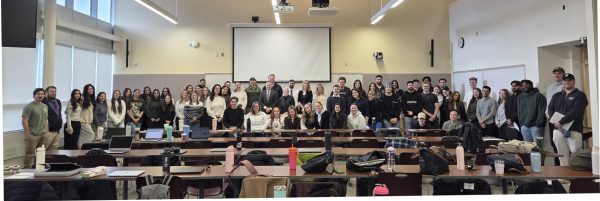
TRU law’s Truth and Rebuilding Canadian Indigenous Legal Relations class with guest speakers Sandra Staats and Alana Hughes (centre)
Litigation’s emotional toll
The speakers highlighted the challenges and emotional labour involved in litigating these cases, particularly in the early years before Canada accepted the harms caused by residential schools. They pointed to Blackwater v. Plint, a landmark decision that exposed abuses committed by church and state actors and the institutional reluctance to accept responsibility.
The case showed how survivors had to fight to have their experiences acknowledged in court, a burden made heavier by the adversarial nature of litigation. Staats and Hughes said representing clients in such cases requires steadfast advocacy, as well as compassion and adaptability.
Student reflections
Garfield Staats, a third-year TRU law student, said it was “an honour” to witness the presentation.
“Alana Hughes and my mother, Sandra Staats, shared their reflections on working in this area of law,” he said. “They made clear how profoundly this work shaped them and how significant their work was for Indigenous communities. The commitment, compassion and resilience they held was so apparent during their presentation.
“I was incredibly proud of the work they have done and the meaningful strides they’ve accomplished in pursuing justice and healing for residential school survivors.”
“The presentation was fantastic,” said third-year student John Hawthorne. “Both presenters shared invaluable insights aligned with the goals of the Truth and Reconciliation course. Their visit was an extremely important contribution to the class.”
Link to reconciliation work
The presentation also touched on the relationship between residential school litigation and the broader movement toward truth and reconciliation in Canada. The speakers reflected on how survivor testimony, both in court and later through the Truth and Reconciliation Commission, helped build a foundation for national awareness and structural reform. The commission’s Calls to Action, many of which focus on justice, child welfare and legal-system reform, highlight the ongoing need for lawyers who practise with cultural competence and trauma-informed sensitivity.
For students in the TRC course, the visit from Staats and Hughes was more than an academic experience. It was an opportunity to learn from lawyers who have stood alongside survivors during some of the most difficult moments of their lives. Their stories underscored the gravity of representing clients who have endured profound trauma, as well as the privilege and responsibility of doing the work respectfully.
TRU professor Murray Sholty said the speakers’ insights offered both critical legal knowledge and a powerful lesson in trauma-informed advocacy.
“They reminded us that representing survivors demands humility, patience and unwavering commitment. It was especially meaningful to host them alongside Garfield Staats, Sandra’s son and a valued member of our TRU Law community, who expressed deep pride in their resilience and dedication to justice and healing.”
The class was honoured to host Staats and Hughes, and their insights will stay with students as they move forward in their legal education and careers. Their presentation served as a reminder that law is not merely a system of rules and procedures, but a human practice rooted in dignity, empathy and the pursuit of justice for those most in need.