
When Dr. Greg Anderson talks about the impact of wildfire, he isn’t just speaking as a researcher. He’s speaking from lived experience.
Before becoming dean of the Faculty of Science at Thompson Rivers University (TRU), Anderson served on wildfire crews in the 1980s, responding to everything from highway vehicle accidents to devastating wildland blazes. The work took its toll. He witnessed scenes that stayed with him, including one that changed how emergency response operates in B.C.
“We didn’t have the protective gear or the equipment, and there were no policies in place to gain access to resources and equipment from neighbouring jurisdictions as we do today,” he recalls. “The exposure was real and the stress was constant.”
That experience shaped a lifelong research focus: understanding stress and resilience in first responders, and developing practical ways to support their mental health.
A human approach to wildfire science
Anderson is an award-winning researcher and educator in occupational, environmental and stress physiology. His work explores how people perform, recover and stay healthy under pressure. His program has secured nearly $50 million in research funding and produced more than 100 publications.
Through his studies, Anderson developed an ecological model of resilience that looks beyond the individual to include the people and systems around them — families, workplaces and peer networks.
“Resilience isn’t something you build alone,” he says. “It’s about the relationships, training and supports that help you respond to stress in a healthy way.”
That philosophy aligns closely with TRU Wildfire, a university-wide initiative addressing the complex and interconnected impacts of wildfire.
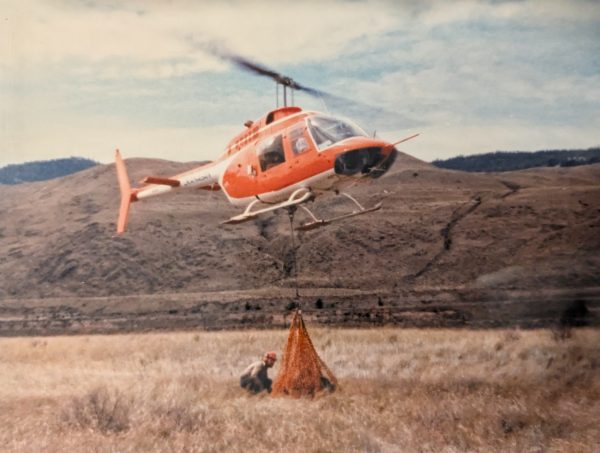
A helicopter transports Dr. Anderson and equipment from a post-fire staging area, carrying him and the crew on to their next assignment.
“Wildfire isn’t just an environmental issue,” says Anderson. “It’s also a human one. The physical, psychological and emotional toll on those who respond — and on the communities they serve — must be part of the conversation.”
Tools for those who protect us
Anderson’s team has created a suite of open-access courses to help public-safety professionals, their families and their workplaces develop skills to recognize and manage stress, and reduce the risk of post-traumatic stress injuries. Modules cover individual stress reduction, family communication and leadership behaviours that foster psychologically healthy workplaces.
The resources support implementation of the Canadian Psychological Health and Safety Standard, giving organizations practical ways to measure progress and sustain conversations about well-being.
“We’re helping people talk about what was once hidden,” says Anderson. “Younger workers are often more comfortable discussing mental health, but mid-career professionals may still see it as a weakness. These tools help bridge that gap.”
His work has been supported by municipal and federal public-safety partners, with primary research fudning from the Canadian Institutes of Health Research, Defence Research and Development Canada, WorkSafeBC and the Law Foundation of BC.
Leading by example
Since joining TRU in 2020, Anderson has guided the Faculty of Science through significant growth, from launching the faculty’s Strategic Academic Plan in 2021 to developing new degrees in data science and engineering at both undergraduate and graduate levels. Additional proposals are in development supporting wildfire science, exercise science, health, environment and new interdisciplinary master’s programs. His leadership emphasizes use-inspired research with real-world impact.
For Anderson, the goal remains deeply personal.
“We teach people how to use the tools of their trade, but we don’t always teach them how to understand themselves,” he says. “We can’t forget that behind every uniform is a human being who needs to stay healthy to do their work.”
Looking ahead
As wildfire seasons grow longer and more intense, Anderson hopes his work will inform how Canada recruits, trains and supports public-safety professionals, from the fire line to the family home.
“It’s about more than equipment or tactics,” he says. “It’s about creating a culture that values the well-being of the people doing this work.”
Anderson’s work connects to TRU Wildfire, a university-wide initiative advancing research, education, training and innovation to address current and future wildfire challenges. Learn more.

Thompson Rivers University is leading in sustainability. Learn more about TRU’s contributions to the UN Sustainable Development Goals.